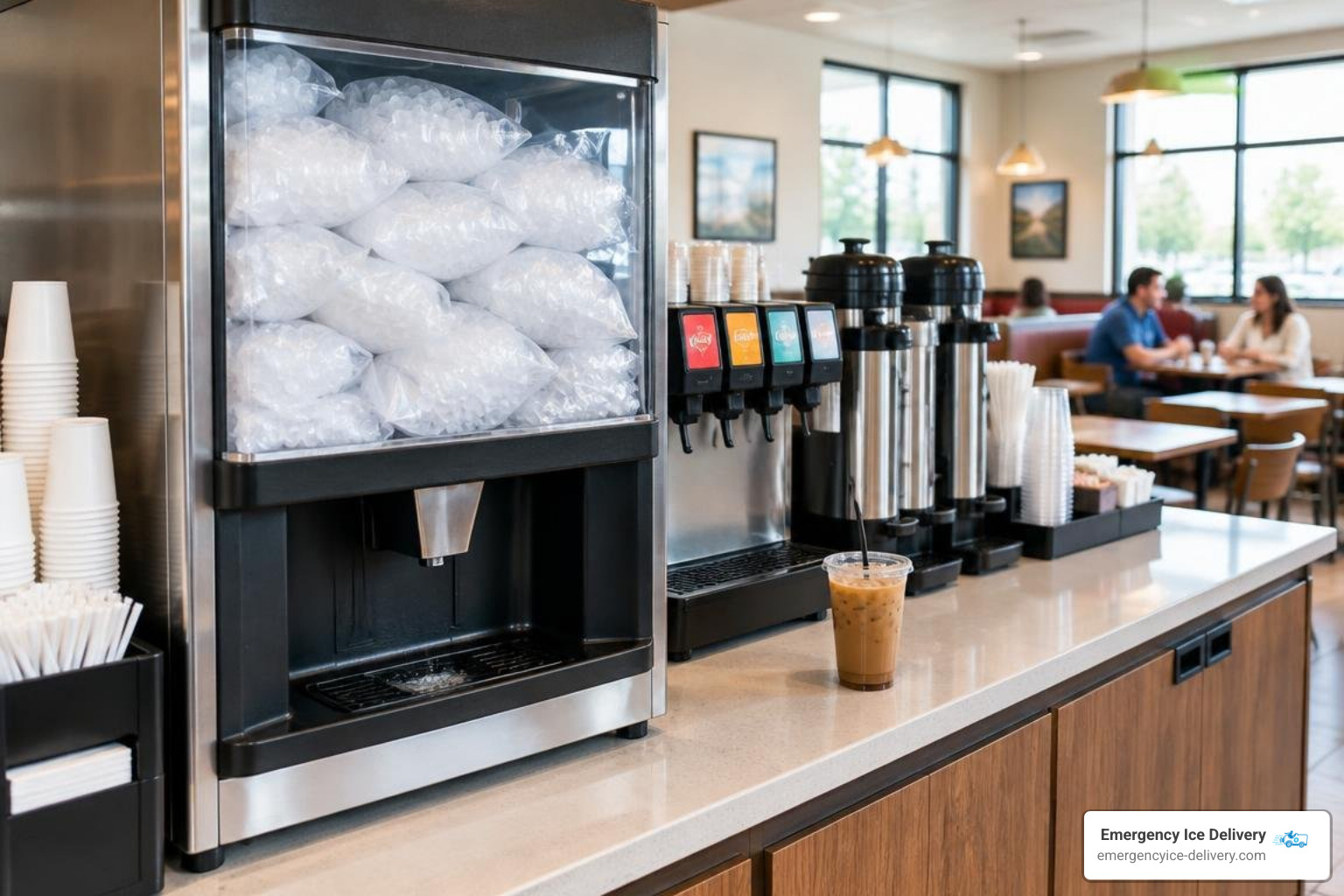
Large Bag of Ice Weight: The Quick Answer

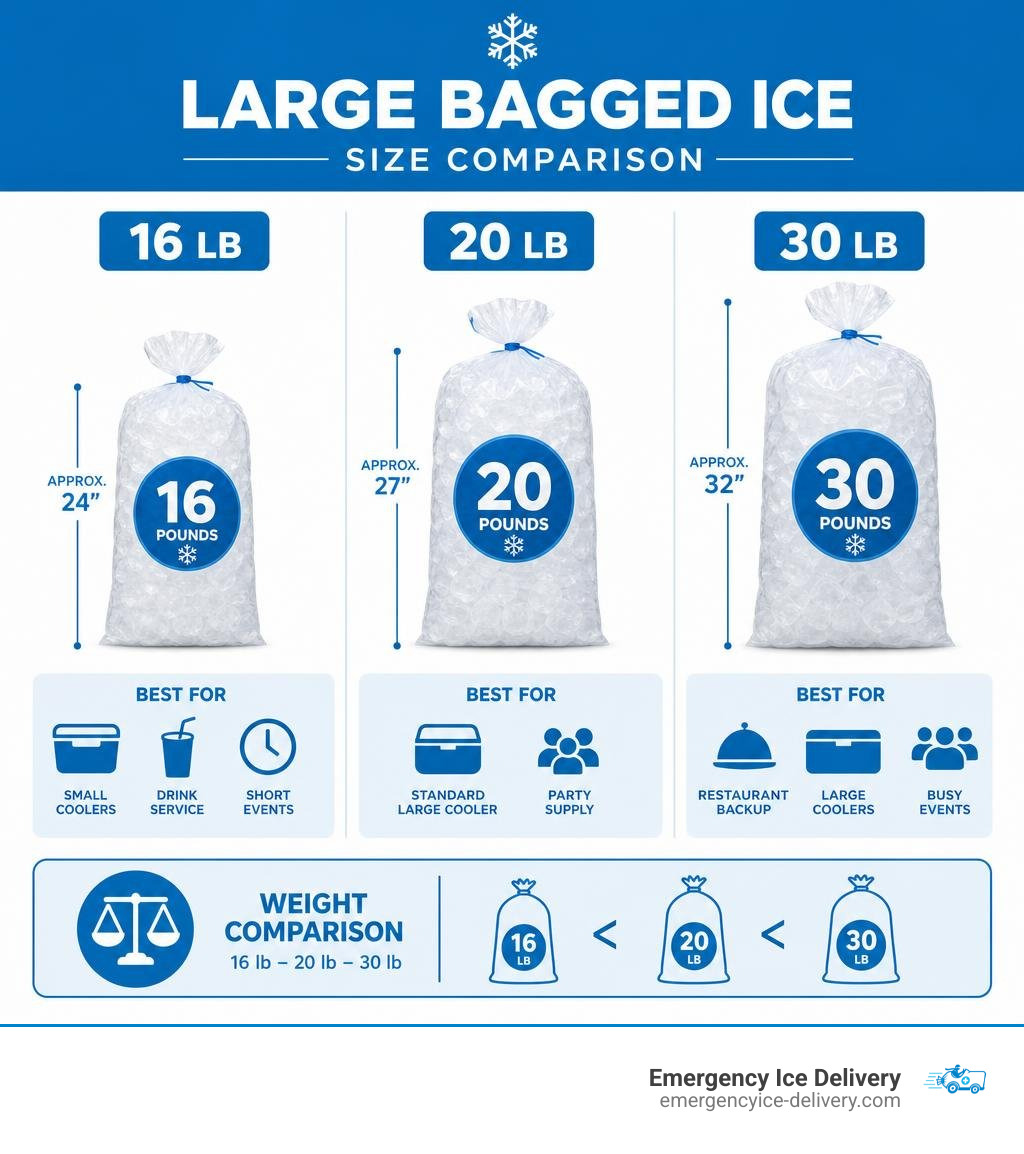
A large bag of ice usually weighs 16 to 30 pounds. For many grocery stores and foodservice operations, 16-pound and 20-pound bags are common. Commercial suppliers may also offer 30-pound bags for restaurants, events, and urgent ice needs.
For fast planning:
| Bag size | Best fit |
|---|---|
| 16 lb | Small coolers, drink service, short events |
| 20 lb | Standard large cooler and party supply |
| 30 lb | Restaurant backup, large coolers, busy events |
A 20-pound bag is a useful benchmark. It can cool roughly 27 canned drinks under typical cooler-packing conditions, but actual capacity depends on the cooler size, how warm the beverages are, and outdoor temperature.
Weight is only part of the decision. Pellet ice, cubed ice, crushed ice, and block ice take up different amounts of room and melt at different rates. For restaurant managers, knowing the bag weight helps prevent a shortfall during a rush, equipment failure, or large event. Emergency Ice Delivery produces and delivers bagged pellet ice for dependable commercial cooling needs.
Understanding How Much Does a Large Bag of Ice Weigh: Standard Categories and Measurements
When organizing an outdoor catering event, managing a busy restaurant bar, or packing heavy-duty coolers for an offshore trip, the question of weight is critical. Knowing exactly how much does a large bag of ice weigh lets you calculate storage limits, vehicle payload capacities, and overall chilling performance.
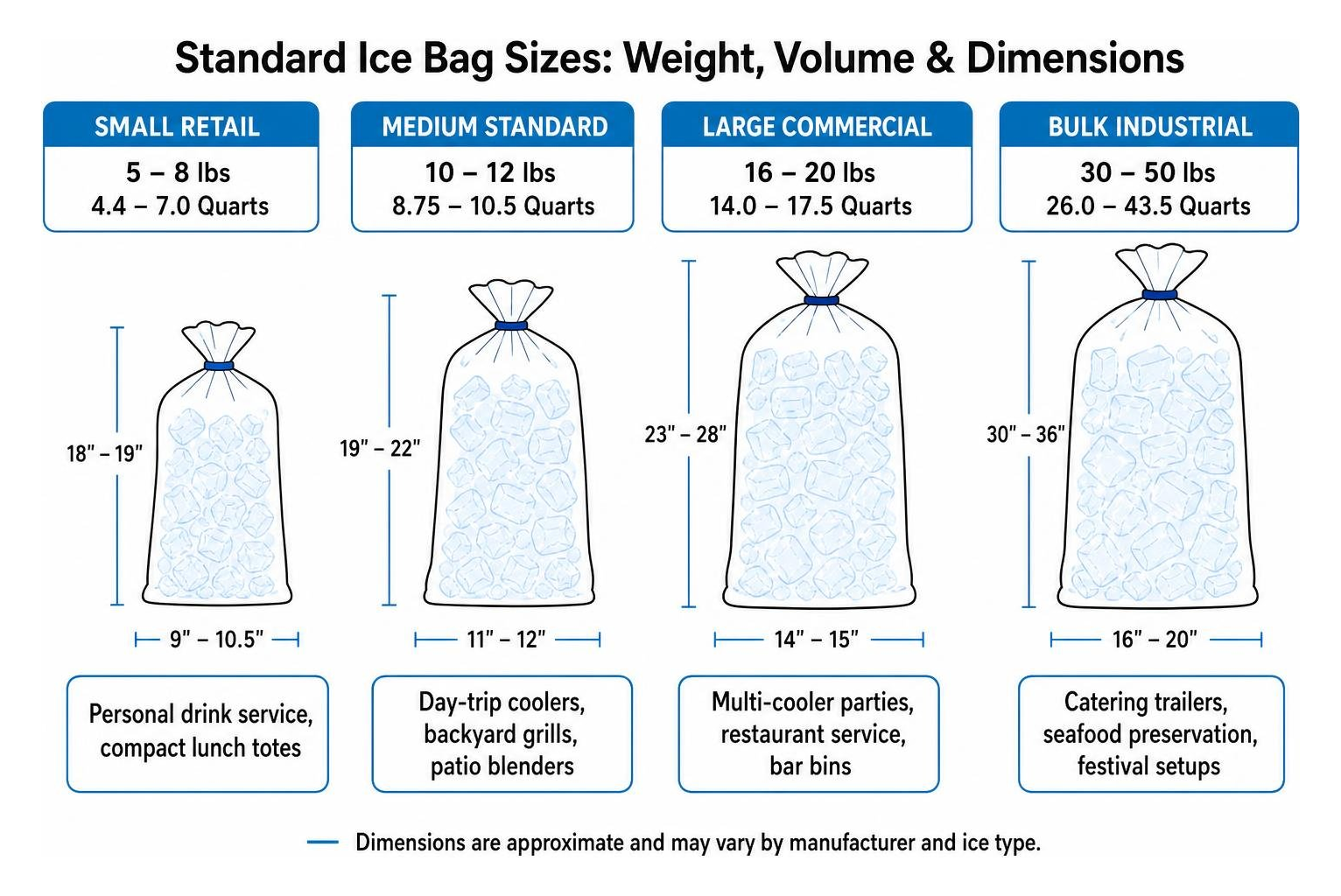
In everyday retail distribution, bagged ice typically spans three categories:
- Small Bags \(5 to 8 lbs\): Designed for single-use drink service, quick blender batches, or small lunch totes.
- Medium Bags \(10 to 12 lbs\): The standard grab-and-go size for tailgates, brief beach outings, and single chest coolers.
- Large Bags \(16 to 30 lbs\): The heavy-duty workhorses utilized by commercial kitchens, catering operations, festival coordinators, and full-day event hosts.
Across service markets in Jacksonville, FL, Charlotte, NC, Columbia, SC, Greenville, SC, and Charleston, SC in 2026, the 20-pound bag serves as the industry’s golden benchmark. It packs enough volume to chill dozens of drinks while remaining light enough for single-person ergonomic lifting. However, retail chains and commercial distributors package ice in distinct increments depending on their equipment, regional shipping constraints, and customer bases.
| Bag Size Category | Standard Net Weight | Estimated Volume Displaced | Primary Real-World Application |
|---|---|---|---|
| Small Retail | 5 – 8 lbs | 4.4 – 7.0 Quarts | Personal drink service, compact lunch totes |
| Medium Standard | 10 – 12 lbs | 8.75 – 10.5 Quarts | Day-trip coolers, backyard grills, patio blenders |
| Large Commercial | 16 – 20 lbs | 14.0 – 17.5 Quarts | Multi-cooler parties, restaurant service, bar bins |
| Bulk Industrial | 30 – 50 lbs | 26.0 – 43.5 Quarts | Catering trailers, seafood preservation, festival setups |
Retail vs. Commercial Ice Bag Sizing
The definition of a “large” bag often shifts depending on whether you are walking into a neighborhood convenience store or ordering from a commercial cold-chain distributor.
At retail gas stations, supermarkets, and discount warehouse clubs, a large bag is commonly classified as 16 to 20 pounds. Large retailers often standardize on 16-pound bags for general consumer convenience, while grocery store chains and wholesale clubs lean into 20-pound options. To maintain durability and prevent bottom-seam failure in sub-zero freezers, manufacturers rely on retail packaging specifications for 20 lb bags built with heavy-gauge low-density polyethylene \(LDPE\) and drawstring closures.
In commercial foodservice and industrial sectors, requirements are higher. Commercial suppliers regularly distribute ice in 20-pound and 30-pound increments, often shipping thousands of pounds per pallet. When hospitality venues face sudden rushes or equipment breakdowns, 20-pound bags provide manageable, modular units that barbacks and kitchen crew can quickly pour directly into beverage wells and holding bins.
Physical Dimensions and Density Standards
Solid water ice features a physical density of approximately 57 to 57.2 lb/ft³ \(917 kg/m³\). Because frozen water expands, it is roughly 8% lighter and less dense than liquid water, which weighs 62.4 lb/ft³ \(or 8.34 lbs per US gallon\). Consequently, one US gallon of solid ice weighs approximately 7.7 pounds.
Because individual pieces of ice contain air gaps between them when packed into a container, bagged ice takes up significantly more volume than a solid frozen block:
- 5 lb Bag: Measures roughly 9” x 18” or 10.5” x 19” \(1.5 mil gauge film\).
- 16 lb Bag: Measures approximately 14” x 5” x 28”.
- 20 lb Bag: Typically measures 15” x 23” to 15” x 24” \(1.85 to 2.0 mil gauge film\).
Commercial ice distributors use metallocene-infused polymer films adhering to heavy-duty bag construction standards to ensure bags endure palletized stacking pressure without bursting during transit.
Factors That Influence Bagged Ice Weight and Volume
While a bag’s label displays a regulated net weight, several environmental and structural variables influence how dense, heavy, and functional that ice is in real-world conditions.

Ice Types: Pellet, Cubed, Crushed, and Block
The physical shape of the ice directly alters how tightly individual pieces settle against one another, creating distinct weight-to-volume profiles:
- Pellet Ice \(Nugget Ice\): Highly popular across restaurants, bars, and healthcare settings. Pellet ice packs closely together with minimal dead air space. It cools liquid beverages at a rapid pace and is soft and chewable, making it a favorite for signature cocktails and sodas.
- Cubed Ice: The standard consumer option. Square, crescent, or cylindrical cubes leave open voids between edges, reducing overall packing density compared to compacted forms.
- Crushed Ice: Crushed fragments nest closely together. A single cubic foot of compacted crushed ice weighs approximately 25 pounds, creating high initial density. However, the vast exposed surface area causes it to melt faster than larger formations.
- Block Ice: Solid frozen blocks eliminate interior air gaps entirely. While heavier and bulkier to maneuver, solid blocks melt at a very slow rate, serving as an enduring thermal base.
To dive deeper into the physical chemistry, material density, and dimensional science of packaged ice, explore this guide to ice bag weight factors and density.
Estimating Weight Without a Label
If you encounter unlabelled or partially melted ice bags in a walk-in freezer or storage cooler, you can estimate the remaining weight using physical formulas:
- The Liquid Water Conversion Formula: A standard 8-ounce cup of liquid water weighs exactly half a pound \(0.5 lb\). If an opened bag melts and yields 14 cups of runoff water, that liquid originally represents 7 pounds of frozen ice. A full 20-pound bag yields 40 cups \(2.5 gallons\) of water.
- Volume Displacement: A 10-pound bag of cubed ice displaces roughly 8.75 quarts \(8.3 liters\) of water. If you drop ice into a calibrated bucket or cooler, every 8.75 quarts of volume displacement equals approximately 10 pounds of ice.
Practical Capacity: Coolers, Drinks, and Event Planning
Planning beverage chilling requires balancing guest counts, cooler dimensions, and ambient outdoor temperatures.
How Much Does a Large Bag of Ice Weigh for Beverage Chilling Needs?
A single 20-pound bag of ice chills approximately 27 standard 12-ounce beverage cans when packed into a cooler with adequate ice coverage. When planning logistics for corporate gatherings, weddings, or restaurant patios, use these event formulas:
- The General Event Rule: Plan for 1 pound of ice per guest for standard indoor gatherings where ice is used primarily for chilling drinks.
- The High-Heat Rule: Plan for 2 pounds of ice per guest when hosting outdoor events in warm, humid weather or whenever drinks are served from unchilled storage bins.
- The Cooler Packing Ratio: Use a 2:1 ice-to-contents ratio \(two parts ice by volume to one part cans/bottles\) for multi-day chilling. For single-afternoon parties, a 1:1 ratio is sufficient.
When running busy hospitality operations across Jacksonville, FL, Charlotte, NC, Columbia, SC, Greenville, SC, or Charleston, SC, unexpected volume spikes can quickly deplete internal ice machines. Businesses rely on our comprehensive bagged ice delivery services to keep beverage wells stocked and coolers packed with fresh pellet ice throughout peak hours.
Cooler Lifespan and Water Yield Calculations
In an insulated heavy-duty cooler, a quality 20-pound bag of ice typically maintains solid structure for 6 to 8 hours under standard opening and closing conditions. To maximize lifespan:
- Pre-chill the cooler: Place a sacrificial bag of ice inside the cooler overnight to drop internal wall temperatures before adding event inventory.
- Keep meltwater drained or plugged appropriately: Keep the drain closed if items need total ice-water submersion for rapid cooling; open the drain if you wish to preserve the remaining ice blocks for extended days.
- Total Liquid Yield: When entirely melted, a 10-pound bag yields 1.2 gallons of water, while a large 20-pound bag produces roughly 2.4 to 2.5 gallons of liquid.
Logistics, Safe Handling, and Storage for Bulk Ice
Moving large volumes of frozen weight requires proper equipment, ergonomic lifting techniques, and controlled storage environments.
How Much Does a Large Bag of Ice Weigh in Commercial and Industrial Operations?
In high-volume foodservice settings across Jacksonville, FL, Charlotte, NC, Columbia, SC, Greenville, SC, and Charleston, SC, ice is a critical food ingredient that must be handled safely and efficiently. Commercial operations use 20-pound bags because they integrate seamlessly into kitchen routines:
- Storage Shelving Limits: A standard commercial wire shelf can support roughly 300 to 500 pounds. Stacking fifteen to twenty 20-pound bags requires distributing weight evenly to avoid shelf bowing.
- Vehicle Load Balancing: Transporting fifty 20-pound bags adds 1,000 pounds of cargo weight. Cargo must be secured low across the axle to avoid load shifting during transit.
For facility managers exploring commercial volume planning and sanitation guidelines, review our direct answers to common commercial ice questions.
Safe Handling and Lifting Guidelines
Lifting ice bags repeatedly can strain back and shoulder muscles if executed poorly. Always practice safe handling:
- Bend at the Knees: Squat down with a wide base of support rather than bending at the waist.
- Keep the Load Close: Hug the 20-pound bag against your chest or abdomen to reduce leverage stress on spinal discs.
- Avoid Twisting: Pivot with your feet when loading ice into high beverage hoppers or chest freezers instead of rotating your torso.
- Use Mechanical Assistance for Bulk Moves: When handling pallets of ice exceeding several hundred pounds, always use pallet jacks, hand trucks, or multi-tiered carts.
Frequently Asked Questions About Bagged Ice Weights
What is the most common weight for a large bag of retail ice?
The most common standard weight for a large bag of retail ice in grocery stores and convenience stations is 20 pounds \(9 kg\) , with 16 pounds serving as another widely distributed large consumer format.
How much liquid water does a 20 lb bag of ice produce when melted?
A 20-pound bag of ice yields approximately 2.4 to 2.5 US gallons \(about 40 standard 8-ounce cups\) of liquid water upon completely melting.
How many cans can a 20 lb bag of ice keep cold in a cooler?
A 20-pound bag of ice comfortably cools approximately 27 standard 12-ounce beverage cans when packed using standard beverage-to-ice ratios in an insulated cooler.
Conclusion
Understanding how much a large bag of ice weighs ensures that your restaurant, event, or catering operation never runs short during critical service windows. While retail bags span from 16 to 30 pounds, the 20-pound bag remains the ultimate standard for balanced handling and heavy-duty cooling power.
When an internal ice machine breaks down or a summer weekend rush drains your bins across Jacksonville, FL, Charlotte, NC, Columbia, SC, Greenville, SC, or Charleston, SC, we are here to help. Emergency Ice Delivery produces and delivers bagged pellet ice directly to your door in as little as 45 minutes with transparent pricing and no hidden surcharges. Simply order bagged ice for your event or business to keep your drinks cold and your operations running smoothly.